Qwen2.5 Technical Report
The Qwen2.5 report describes a general language-model family, its pretraining pipeline, instruction tuning, and capability evaluations.
Problem
A general language model must cover knowledge, reasoning, coding, multilingual communication, and instruction following under different compute budgets. The report addresses how training data, model scale, and post-training can support that breadth. Qwen2.5-7B-Instruct is a text-generating member of this family; the report does not define a GUI-specific model or screenshot action policy.
Contributions
A family of pretrained and instruction-tuned language models is documented alongside the architecture and deployment characteristics of the released dense checkpoints.
The pretraining recipe combines improved filtering, domain balancing, mathematical and programming data, synthetic examples, and context-length extension.
Post-training separates supervised instruction learning, offline preference optimization, and online reinforcement learning, with additional procedures for long-context models.
Method
The dense models use a decoder-only Transformer with grouped-query attention, rotary position embeddings, gated feed-forward layers, and normalization before the main sublayers. The family shares a byte-level tokenizer. The report also describes mixture-of-experts models, but those are distinct variants rather than the architecture of the released dense 7B checkpoint.
Data preparation uses model-assisted quality assessment and domain classification to filter and balance the corpus. Specialized mathematics and coding data supplement general text. Synthetic examples pass further quality checks. Hyperparameter studies guide learning-rate and batch-size choices, and later training stages extend the context window.
Supervised fine-tuning covers instruction following, structured information, long responses, reasoning, and multilingual tasks. For offline preference training, sampled responses are checked through answer matching, execution feedback, or review; passing and failing candidates form preference pairs. Online training samples responses and uses a reward model with group-relative optimization.
The official 7B-Instruct model card supplies its chat formatting and context configuration. Those checkpoint-specific details delimit how the family-level report maps to a concrete model used in another system.
Evaluation
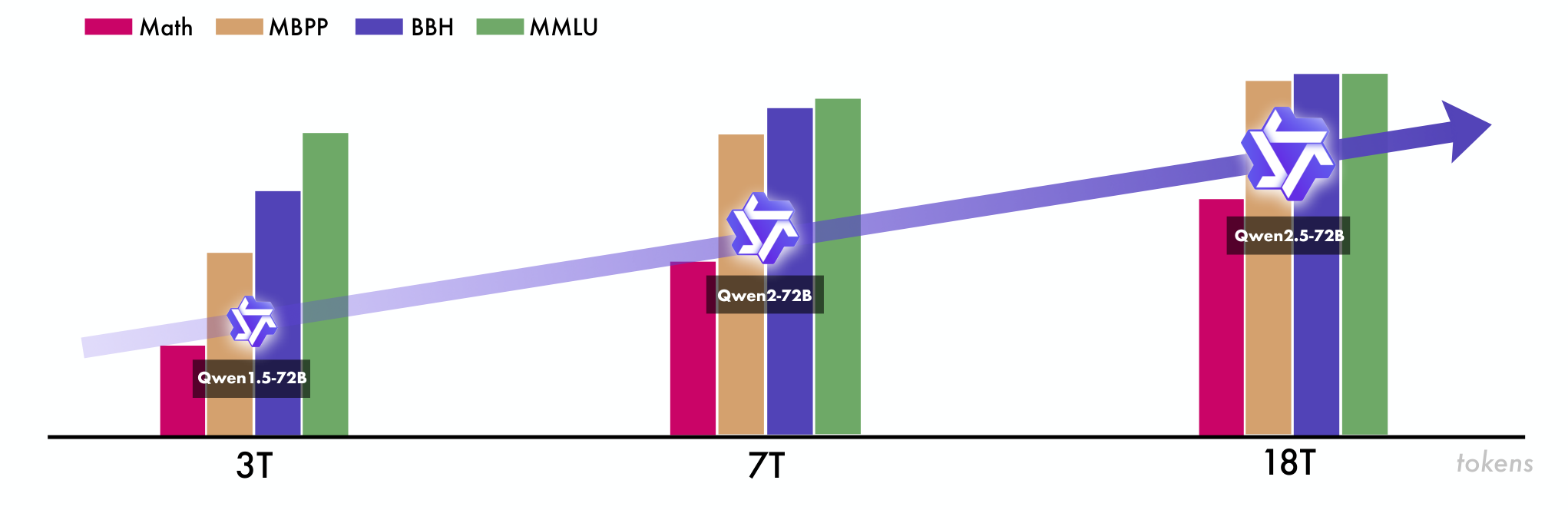
Base and instruction-tuned models are evaluated separately. Tasks span knowledge and reasoning, mathematics, code generation, multilingual understanding, translation, instruction compliance, and conversational response quality. Representative benchmarks include MMLU, GSM8K, HumanEval, and IFEval.
Long-context tests examine retrieval and comprehension as input length changes. Comparisons across model sizes and prior checkpoints characterize the training recipe; they do not establish visual grounding or GUI-navigation capability.
Open this note in the interactive notebook (comments, hooks) → · All notes