Critique of Agent Model
The paper proposes an agent architecture that explicitly models goals, identity, planning, self-regulation, and learning rather than locating their control entirely in an external workflow.
Problem
Systems called agents often rely on external orchestration to decide their goals, schedule reasoning, maintain memory, and organize learning. The paper argues that fluent interaction or tool use alone does not show where these organizing functions reside.
It distinguishes externally orchestrated agentic systems from agentive systems that internalize more of this control. The central problem is architectural: how to represent persistent, goal-directed behavior and adaptive computation as explicit components that can be trained, inspected, and evaluated.
Contributions
A capability-based framework for analyzing goals, identity, decision-making, self-regulation, learning, and coordination in agent systems.
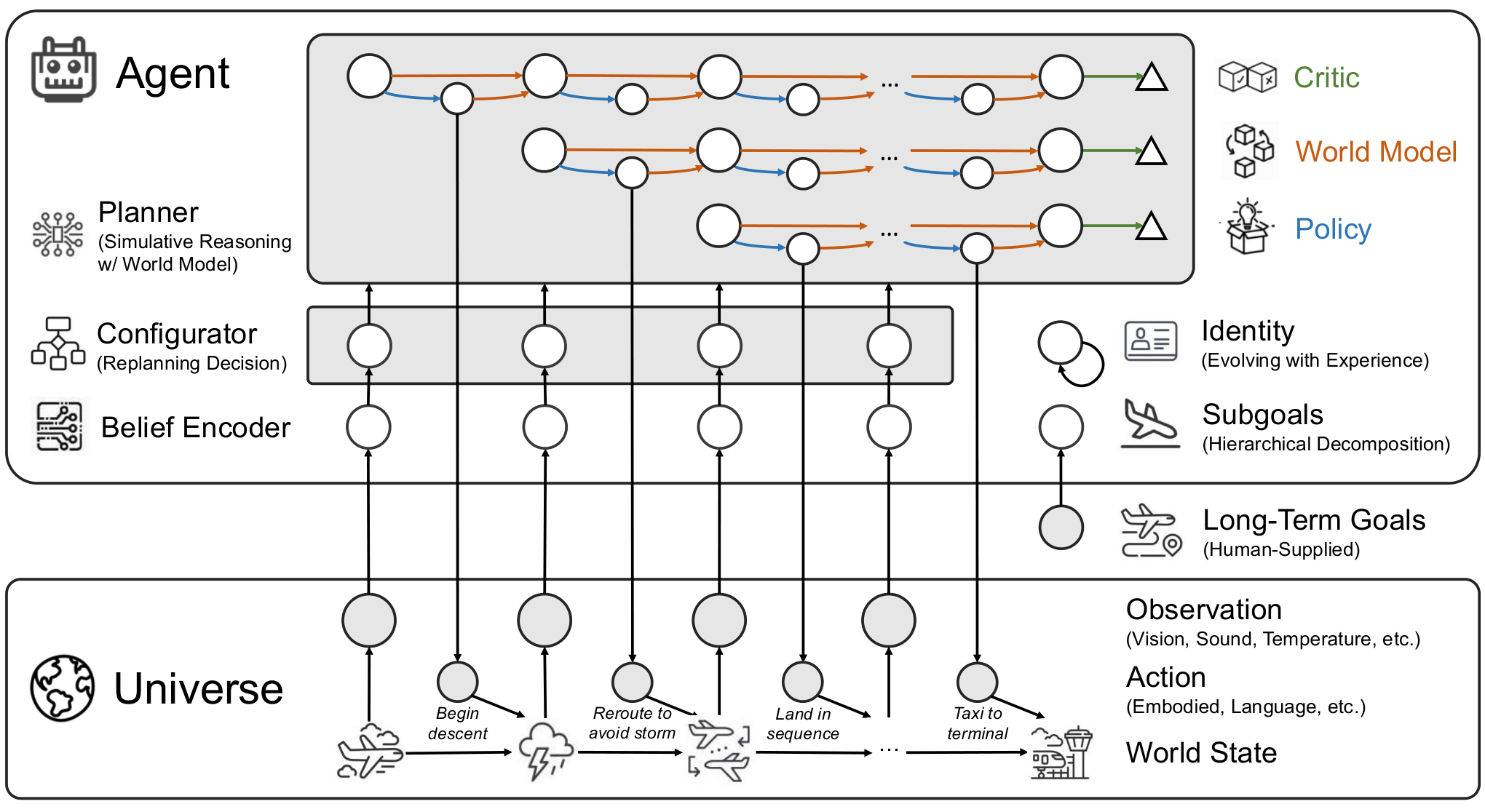
The Goal–Identity–Configurator architecture, connecting hierarchical goals and an evolving self-model with reactive policy execution and model-based planning.
A proposed training strategy and Performance–Efficiency–Growth evaluation framework for studying competence, computation allocation, and improvement over experience.
Method
A human supplies the terminal goal, which is decomposed into subgoals. A belief encoder summarizes observations, while identity represents the agent's capabilities, constraints, and dispositions and can evolve with experience. These states provide context for choosing actions and revising how the task is organized.
The configurator decides whether to act reactively, continue a cached plan, or invoke deliberate planning. Planning uses a policy, a separately trained world model, and a critic to generate and assess possible trajectories. The architecture distinguishes predicting environmental dynamics from selecting behavior toward a goal.
The proposed training process initializes components with different signals, develops competence through simulated experience, and refines components through real interaction. World-model prediction, policy learning, critic learning, and computation-allocation decisions have different training objectives. During deployment, the design allows acting, simulation, reflection, and learning to be interleaved under configurator control.
Evaluation
The paper presents an architectural and analytical argument rather than an experimental validation of the complete GIC system. Its aircraft-pilot scenario illustrates component roles. It references companion work for preliminary evidence, while proposing a broader evaluation agenda.
Performance evaluation uses long-horizon, constrained, stochastic, transfer, and coordination tasks to isolate different capabilities. Efficiency examines latency, computation, planning frequency, and whether deliberation is allocated according to difficulty. Growth examines learning from fixed experience, exploration under a fixed interaction budget, and transfer to unfamiliar tasks. These proposed measurements do not establish delegated authorization or resistance to prompt injection.
Open this note in the interactive notebook (comments, hooks) → · All notes