GUIOdyssey: A Comprehensive Dataset for Cross-App GUI Navigation on Mobile Devices
GUIOdyssey provides cross-application mobile demonstrations and a history-resampling agent for studying navigation across tasks, apps, and devices.
Problem
Mobile workflows often require carrying information from one application into another. The current screenshot may omit details needed for the next action, while retaining every earlier screenshot is costly. GUIOdyssey addresses both the shortage of cross-app demonstrations and the representation of visual history in an agent.
Contributions
A mobile dataset records human demonstrations across applications and devices, with high-level instructions and additional semantic annotations for individual steps.
OdysseyAgent adds a learnable history resampler to a vision-language model, compressing past screenshots before predicting the next action.
Separate random, app, task, and device splits distinguish in-domain evaluation from several forms of generalization.
Method
Human demonstrators carry out designed cross-app tasks on mobile devices. The recordings preserve screenshots, actions, and the task instruction. Additional annotations describe finer-grained operations and interaction semantics, supporting experiments with either high-level goals or more explicit step-level instructions.
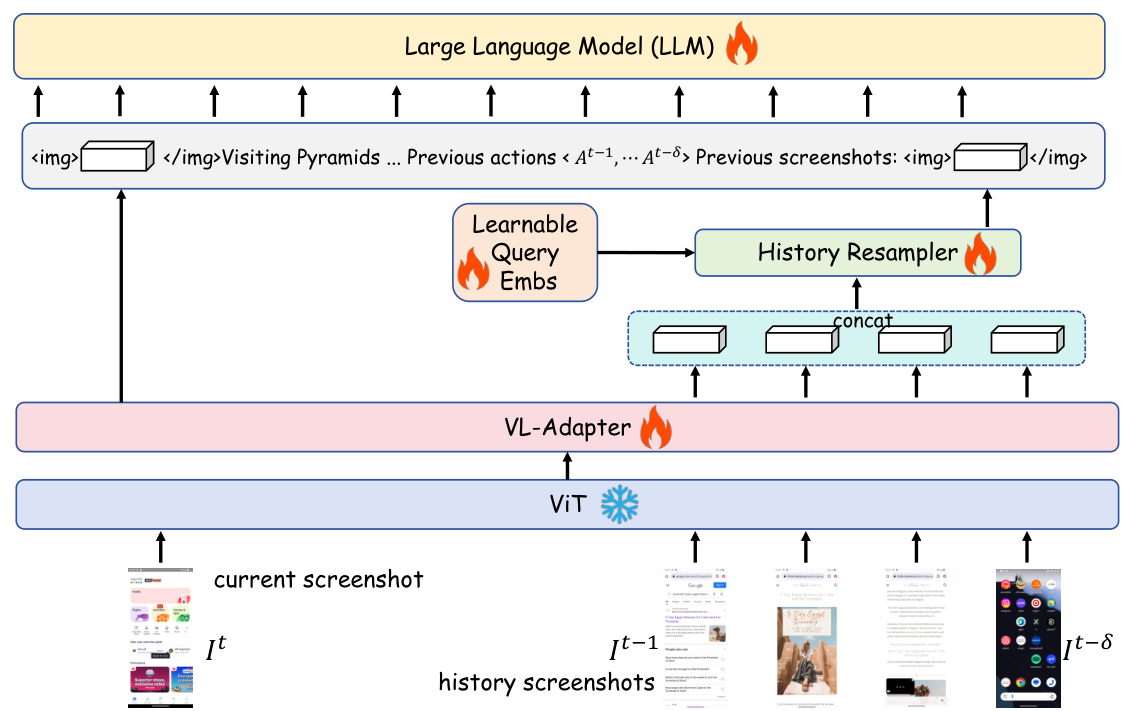
OdysseyAgent builds on Qwen-VL-Chat, retaining its vision encoder, vision-language adapter, and language model. A history resampler uses learnable query embeddings to attend to visual tokens from earlier screenshots. This cross-attention converts a potentially long visual history into a shorter set of representations.
The compressed history is combined with the current screenshot, user instruction, and preceding actions. The language model predicts the next operation as a token sequence. Training adapts the vision-language adapter, history resampler, and language model to the demonstrations. The method therefore combines visual memory with the textual record of earlier actions, rather than treating them as interchangeable sources of context.
Evaluation
The ICCV version evaluates held-out recordings under random, unseen-app, unseen-task, and unseen-device conditions. It compares high-level and low-level instruction settings and tests the addition of semantic annotations.
Action Matching Score checks operation type and operation-specific arguments. Pointing actions use spatial or target-region criteria, scrolling checks direction, and typing uses string similarity. Episode success requires the entire annotated action sequence to match, making it an offline sequence metric rather than an independently checked final application state.
Ablations remove history components, vary the amount of history, and compare the resampler with direct multi-image input. These tests investigate which context helps action prediction and the computational cost of representing it.
详细阅读笔记 · P001
本笔记保留阅读时的论文版本、来源与实验边界。文中“你的方案/当前方案”等比较反映当时的讨论;当前研究方向见分类页。自拟例子与复现建议不是作者实验结果。
原论文 · P0 · 历史视觉重采样与数据集。核查日期:2026-09-07。
0. 摘要
中文转述。GUIOdyssey提供跨应用手机操作轨迹,OdysseyAgent用可学习的history resampler把旧截图压成较少视觉token,再结合当前图、指令和动作历史预测下一步。它直接研究“过去看过什么如何保留”,是压缩历史视觉表示的基础对照。
1. 方法动机
跨应用任务往往要在一个应用查信息,再在另一个应用使用。只看当前空白输入框不知道该填什么;把每张旧图全送入语言模型又很贵。作者希望压缩旧图特征而保留任务线索,当前图仍承担精确定位。
2. 方法设计
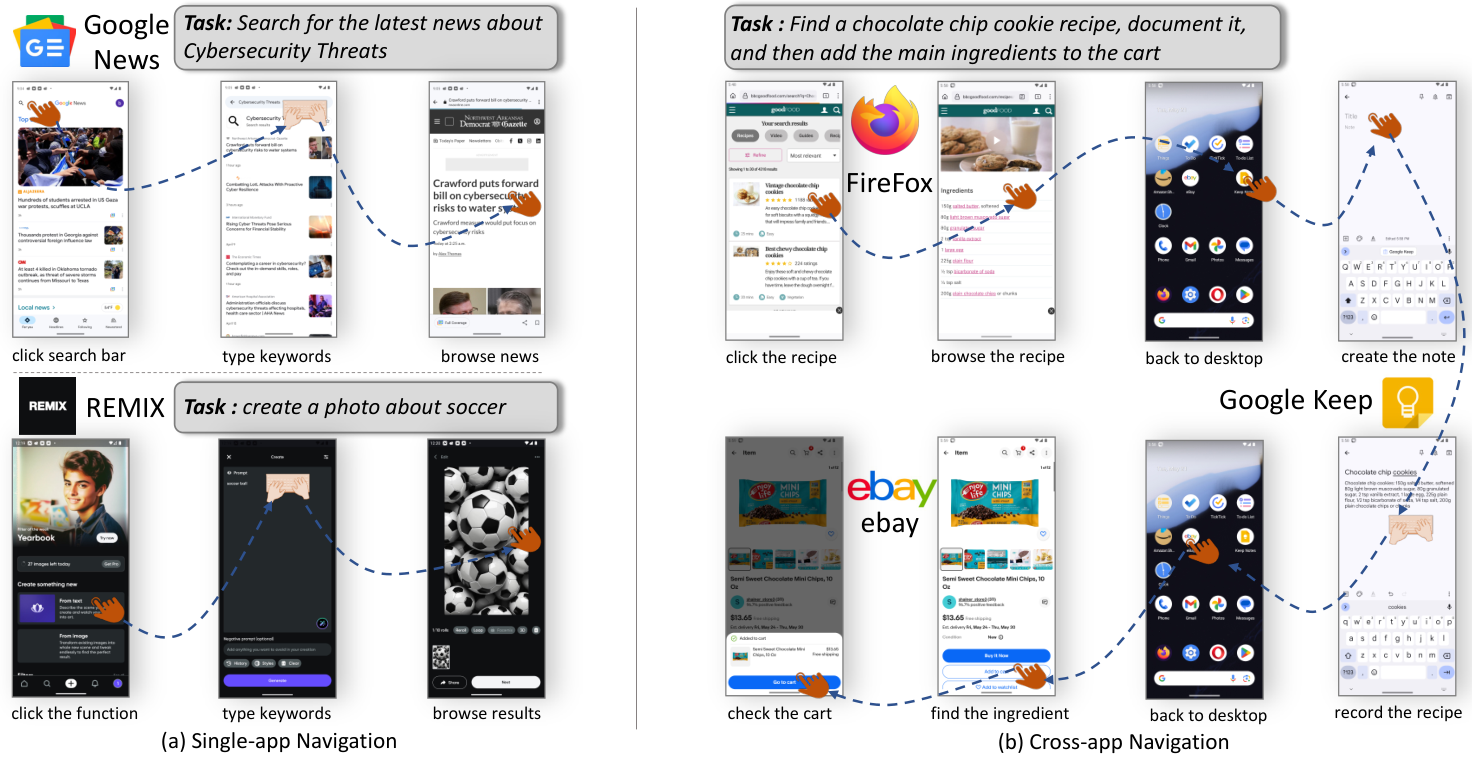
作者图注与上下文。原图用于定位所述流程,下面的演示例子均另外标明。
原文3:采集跨应用轨迹并标注动作语义
数据含8334条轨迹、212个应用、1357种应用组合、6类设备,平均约15.3步。除低层动作,语义标注提供动作意图及此前步骤的上下文信息。语义摘要是显式文本历史,不等同于模型自己在正式执行时稳定生成无误摘要。
原文4:用单层交叉注意力重采样旧图
模型基于Qwen-VL-Chat。每张旧截图先视觉编码,学习到的一组query去读取旧图token作为key/value,得到数量更少的历史表示。随后拼接当前图token、用户指令和之前动作,由LLM生成下一动作。
自拟例子:先在浏览器读到会议地点,再到日历创建活动。历史resampler有机会保留地点视觉信息;当前日历截图提供输入框位置。这里没有为地点建立可搜索的数据库记录,模型也不能按记录ID重新读取已被窗口排除的原图。
原文5.3:文字历史、视觉历史与语义上下文分别消融
作者比较只加动作、只加截图、只加语义上下文,以及组合。语义上下文单独就带来明显收益,因此不能把所有历史收益都归因于视觉token。对于你的方案,需要同样保证“优质文字状态表”作为强基线。
3. 训练与调用
在GUIOdyssey上微调VL adapter、history resampler和LLM;它不是完全免训练的缓存策略。运行时每步仍观察和调用动作模型,旧图需先视觉编码;压缩发生在送入LLM之前。论文没有实现YOLO图标库、语义top-k历史裁图召回或跨轮直接复用所有KV。
4. 实验如何读
表4汇总:无历史AMS55.60/SR1.49;仅历史动作63.44/5.18;仅旧截图60.30/4.20;仅语义上下文64.77/5.06。AMS是动作匹配,SR按数据轨迹严格匹配,和在线环境终态检查不同。正文还分随机、跨任务、跨应用、跨设备设定,不能拿某一个最好的划分当全部成绩。
5. 附录
附录8给任务、动作集、语义标注与样例;9给训练和评测提示;10.1比较resampler与直接多图输入的性能及首token延迟,10.2分别考察语义标注,后续比较指令粒度、设备和单/跨应用。首token延迟改善不能直接写成整个手机任务同幅提速。
6. 对方案的作用
建议比较固定窗口原图、resampler压缩、纯文本语义状态与外部证据检索。OdysseyAgent压缩成潜在表示后,细节难按ID回查;你的可回查原图可以弥补这一点,但需证明相同成本下确有收益,并分清视觉编码、LLM预填充和检索开销。
7. 来源与核查范围
原文完整表格附件保留本版本可抽取的正文及附录表;正文解释关键比较,不把异构数据集或不同模型拼为统一排行榜。
原论文:章节、图注与来源 / Original paper。章节包括:1 Introduction;2 Related Work;3 GUIOdyssey Dataset;3.1 Metadata Definition;3.2 Data Collection;3.3 Dataset Statistics;4 Method: OdysseyAgent;5 Experiment;5.1 Experimental Setup;5.2 Comprehensive evaluation on the GUIOdyssey;5.3 The effect of different historical information.;6 Conclusion;Acknowledgments and Disclosure of Funding;References;7 Ethical Discussion;8 Details of GUIOdyssey;8.1 Description of Task Categories;8.2 Action Set;8.3 Fine-grained Episode Annotation Generation;8.4 Examples;8.5 Data Format;9 Experiment Details;9.1 Detailed description of four different setups.;9.2 Training Details.;9.3 Prompt for Evaluation.。
Open this note in the interactive notebook (comments, hooks) → · All notes