M2A: Multimodal Memory Agent with Dual-Layer Hybrid Memory for Long-Term Personalized Interactions
M2A maintains editable semantic memories with pointers to immutable multimodal messages and retrieves through text and image indexes.
Problem
Long-term personalized dialogue needs concise, updateable knowledge without losing the original visual details and messages that support it.
Contributions
M2A combines a raw-message layer, a semantic-memory layer, hybrid retrieval, and an agentic memory manager, evaluated on personalized multimodal conversations.
Method
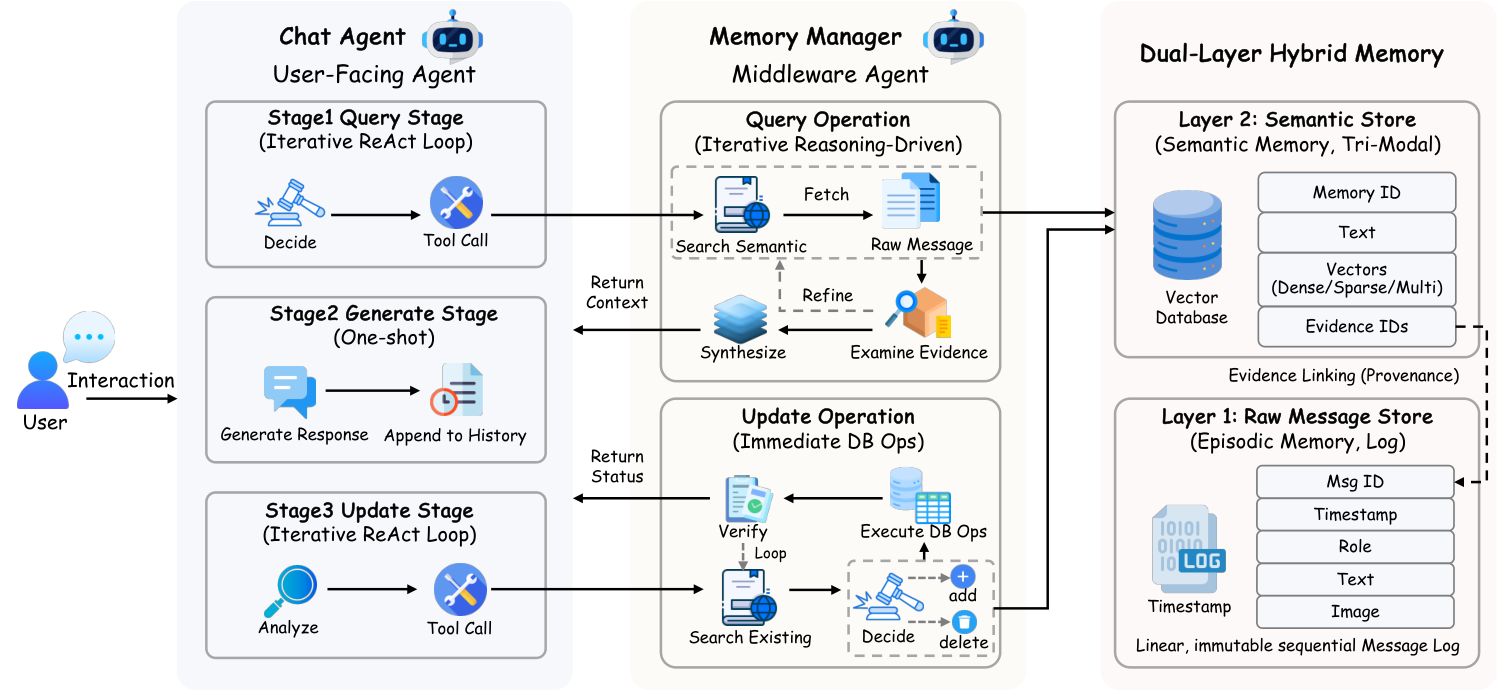
The raw store retains text, image references, timestamps, and message IDs; semantic entries contain extracted descriptions and pointers to supporting message spans.
Dense text, BM25, and image retrieval each return candidates, which are combined by reciprocal-rank fusion; the reported implementation retrieves ten per channel and uses fusion constant 60.
A ChatAgent requests memory when needed, while a MemoryManager retrieves semantic candidates, follows pointers into raw evidence, and can add, revise, or delete semantic entries.
Evaluation
With GPT-4o-mini, the two-judge mean answer score is 44.64 for M2A versus 33.27 for RAG; these are personalized question-answering results, not GUI execution success.
For Qwen3-VL-8B, the full system scores 54.69 versus 41.38 with semantic memory only and 38.67 with one retrieval round; these ablations also change computation and do not establish equal-latency gains.
详细阅读笔记 · SUP-A27
本笔记保留阅读时的论文版本、来源与实验边界。文中“你的方案/当前方案”等比较反映当时的讨论;当前研究方向见分类页。自拟例子与复现建议不是作者实验结果。
原论文 · P0 · 摘要与原始视觉证据双层记忆。核查日期:2026-09-07。
0. 摘要
中文转述。M2A在长期图文对话中保存两层记忆:不可变的原始消息,以及从中提取的语义记录。语义条目附带图片和原始消息范围的证据指针;查询时先定位高层记录,必要时沿指针回查原始细节。这个结构与“历史摘要+图像memory+按需RAG”高度接近,应先读。
1. 方法动机
将所有经历压成摘要会丢细节;只保留原记录又难检索。用户可能逐步给一个物品起昵称、补充外观、后来修改偏好,单轮视觉识别不能保证长期一致。作者以隐含用户状态为概念框架,用可更新记忆近似已知信息;不是直接观测用户的完整真实状态。
2. 方法设计
作者图注与上下文。原图用于定位所述流程,下面的演示例子均另外标明。
原文4.2:原始消息不能被摘要更新覆盖
RawMessageStore逐轮保存文本、图片引用、时间和消息编号,作为历史事实底稿。SemanticMemoryStore保存文本语义、图片描述、关联图片及指针集合ptr,指向支持该条目的原始消息区间。更新语义层时原始记录仍在。
自拟GUI例子:语义条目写“用户刚才选过蓝色星形收藏夹”,指针指向第8步截图和动作。模型以后不清楚星形边框是实心还是空心,可以沿指针回到该图。论文已有证据链接;不能把增加一个screenshot_id当作单独创新。
原文4.2:三个检索通道互补
一条语义记录同时形成稠密文字向量、BM25稀疏表示和图像向量。文字向量捕捉近义词,BM25保留昵称/编号等精确匹配,视觉向量支持图文或图像相似检索。实现每路取top-10,再用RRF合并,常数k=60;这个60是排名融合常数,不是最终保留60张图片。
原文4.3:交互代理决定要不要问记忆管理器
ChatAgent按查询、生成、更新三个阶段运作,按当前对话决定是否请求长期记忆。MemoryManager拥有实际读写权限,拿到请求与近期上下文后,先找语义候选,再查看其指向的原始消息,必要时继续缩小范围。它还可新增、修改或删除语义条目。两个角色可用同一类底座多次调用;不能把这种角色分工描述成只需一次主模型前向。
原文4.4:准备含个人视觉概念的长对话
作者把Yo'LLaVA和MC-LLaVA的个人概念加入LoCoMo长对话,在时间线上插入图像和后续提问,检查概念、别名与时间一致性。它是长期个性化图文问答,未执行鼠标点击;原始消息证据也不是当前屏幕坐标。
3. 模型和训练边界
主要使用现成ChatAgent/MemoryManager模型和索引;论文的系统提示及数据合成是关键配置。all-MiniLM-L6-v2做文字嵌入,SigLIP-Base-Patch16-384做图像嵌入,Milvus管理语义条目。不同底座均测试,不能默认作者的记忆模块就是一个3B压缩器。
4. 结果和消融
主表用两个独立裁判Qwen3-VL-32B与GPT-4o给正确/错误,再平均。GPT-4o-mini整体均分M2A44.64,RAG33.27,Mem0 34.73,A-MEM36.26;视觉中心问题M2A43.27,RAG30.69。它们是问答判分,不是GUI任务成功率。
Qwen3-VL-8B消融表2:
| 配置 | 两裁判平均准确率 |
|---|---|
| 完整M2A | 54.69 |
| 只保留语义层 | 41.38 |
| 只做一次检索 | 38.67 |
| 仅稠密文本检索 | 50.59 |
它支持原始证据、多轮取证与混合索引的作用,但移除一个模块也会改变计算量;不能据此断言在相同延迟下有同样收益。
5. 附录与限制
附录B解释基线,C详述数据合成与时间插入,D给ChatAgent、MemoryManager和裁判提示。近期上下文长度实验显示给管理器少量近期对话明显有帮助,继续增加收益变小。没有提供GUI在线执行、当前状态失效检测、旧坐标可点击性或完整任务成本的证明。
6. 对拟议方案的作用
这是必要的结构基线:保留原始截图记录+语义层+三路索引+按需回查。新课题若只换成YOLO/OCR和3B摘要,更多是工程适配。可能的贡献应检验GUI特有决策:历史证据有用不代表现在仍成立;候选图标重现时要在当前图重新定位;按动作风险和证据缺口选择最小历史区域;并通过反事实同当前画面、不同历史的任务验证行动改变。
7. 来源与核查范围
原文完整表格附件保留本版本可抽取的正文及附录表;正文解释关键比较,不把异构数据集或不同模型拼为统一排行榜。
原论文:章节、图注与来源 / Original paper。章节包括:1 Introduction;2 Related Work;Personalized multimodal models.;Long-context memory and agentic memory management.;3 Problem Formulation;Latent user state.;Transitions and observations.;Belief state as memory bank.;4 M 2 A: Multimodal Memory Agent;4.1 Framework Overview;4.2 Dual-Layer Hybrid Memory;Layer 1: Raw Message Store.;Layer 2: Semantic Memory Store.;Tri-path hybrid retrieval.;4.3 Agentic Collaboration;ChatAgent workflow.;MemoryManager operations.;Motivation for agent collaboration.;4.4 Multimodal Chat Dataset Construction;5 Experiment;5.1 Experimental Setup;Datasets.;Baselines.;Evaluation metrics.;Implementation details.。
Open this note in the interactive notebook (comments, hooks) → · All notes