A Task-State Representation for Long-Horizon Mobile GUI Agents
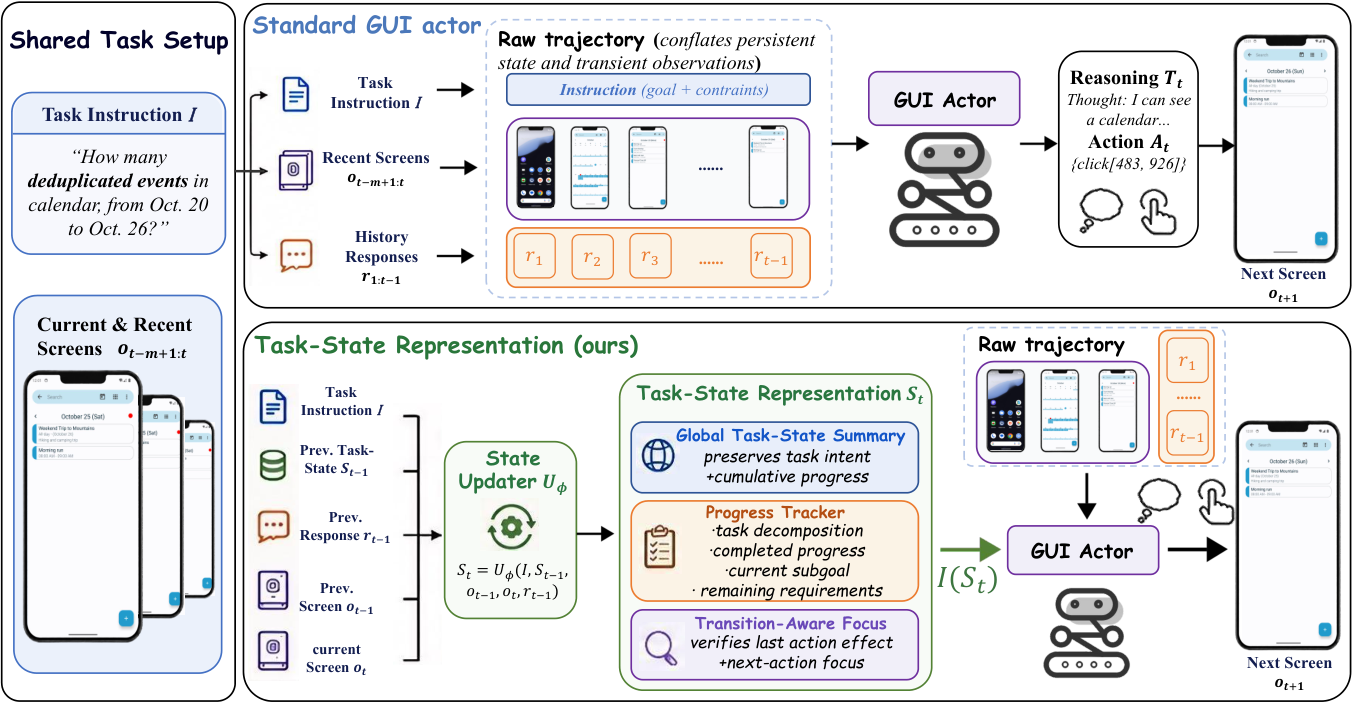
TSR adds an external updater that checks action outcomes and maintains structured goals, progress, and transition-aware guidance for a fixed GUI actor.
Problem
Recent screenshots and past action intentions do not reliably establish which requirements have actually been completed during a long mobile task.
Contributions
The method supplies a unified task-state representation with a global summary, a progress tracker, and transition-aware focus without training new parameters.
Method
After an action, the updater reads the task, previous state, prior response, and pre/post screenshots, then revises all three state fields in one JSON output.
The actor receives this state in addition to its existing text history and recent screenshots; TSR adds context rather than replacing all history with a bounded summary.
The reported configurations use the same model family for actor and updater, with one extra update call per step and no historical-image retrieval tool.
Evaluation
On the 100-task GUI-only MobileWorld set, Qwen3.5-plus improves from 43% to 55% success and Kimi-k2.5 from 49% to 58%.
Benefits are not universal: Qwen3.5-plus falls from 61.21% to 57.76% on AndroidWorld, and removing transition-aware focus raises that result to 63.79%; additional calls and possible state-update errors remain material costs.
详细阅读笔记 · SUP-M05
本笔记保留阅读时的论文版本、来源与实验边界。文中“你的方案/当前方案”等比较反映当时的讨论;当前研究方向见分类页。自拟例子与复现建议不是作者实验结果。
目录 / Contents
原论文 · 优先级 P0 · 复核日期:2026-09-07
同任务结构化目标/进度/动作后果状态。与研究方案的关系:每步辅助模型比较前后截图更新历史状态;近期工作,必须与小模型摘要方案比较。
0. 摘要
中文转述,非逐句翻译。TSR在固定GUI执行器外面加一个状态更新器,每步比较动作前后截图,把原目标、已完成/剩余子任务和动作验证结论写入结构化状态,再附到执行器输入。它不训练新参数,也没有删掉执行器原有文字历史。
1. 方法动机
近期截图只能显示当前页,过去的模型思考又主要反映意图,不能证明操作成功。长任务容易忘记初始要求、误记完成进度,或因页面更新慢而反复点同一按钮。作者将持续任务状态与短暂页面观察明确分开。
2. 按原文小节解释方法
原文§2.1 Problem Formulation
基线保留最近m张截图和全部历史思考/动作。旧截图被截断后,执行器难以从动作意图推断真实进度。TSR针对这一输入组织缺陷加入额外状态,而非改变点击定位底座。
原文§2.2 Global Task-State Summary
长期摘要保持原始要求及累计进度,防止代理被当前页面带偏。它是统一JSON对象里的一个字段,与另外两种状态联合更新,并非额外独立模型。
原文§2.2 Progress Tracker
把任务拆成原子要求,记录分解项、已完成里程碑、当前子目标、剩余要求。进度要以观察到的结果更新,不能仅因上一步计划写“保存”就打勾。拆得过细也可能使代理逐项检查而超出步数预算。
原文§2.2 Transition-Aware Focus
用动作前后画面检查上一操作有无生效。若不确定,则提出下一步先验证、刷新或等待等关注点,避免对延迟界面盲目重复。它输出建议而不是可靠的环境真值,仍需服从当前实际画面。
原文§2.3 State Update and Actor Injection
初始状态只从任务生成;之后一次状态更新调用同时输入任务、旧状态、上一响应和前后截图,输出全部三类字段。序列化后附到原执行器输入,原思考/动作历史仍在;故不能称固定历史预算或整体压缩方法。
自拟例子:删除收藏但列表未刷新
代理点了删除,旧条目短时仍显示。状态更新器写“删除效果待确认,先刷新核验”,执行器避免再点几次。若后来需要被删除条目的原名称,只有进度状态可能不够,你的历史证据库可保留被删除前的原区域供查询。
3. 模型输入输出与训练/推理分工
状态更新器:任务+旧状态+上一动作/思考+前后两图→JSON状态;Actor:任务+近期图+完整文字历史+状态→下一动作。两种实验中Actor和更新器都用同类Qwen3.5-plus或Kimi-k2.5,温度0;不是论文已验证了3B摘要器。
无SFT/RL,每步额外一次模型调用,更新器最多1024输出token。Actor最多2048输出token,观察窗口为3张近期截图;提高成功率需同时计这次更新延迟与费用。模块都输出文字,没有检索本轮旧图的工具。
4. 实验、指标和原表解释
表1 MobileWorld GUI-only100题:Qwen3.5-plus SR43→55、平均25.1→27.0步;Kimi49→58、29.6→28.3步。AndroidWorld Qwen61.21→57.76反而下降。MemGUI-Memory Qwen23.48→28.70、65.4→64.5步,Kimi37.39→40.87、55.5→60.6步。SR为各在线基准成功判定;步数可因坚持完成困难任务而增加,不应自动当低效。
5. 消融、附录与证据限制
表2 MobileWorld完整55,去摘要50、去进度49、去转移48;AndroidWorld完整57.76,去转移反而63.79,高于基线61.21。论文明确承认状态更新器会传播错误、增加每步调用、对短任务过度分解。附录A–E给任务筛选、动作、模型和完整提示,可据此复现公平外部状态基线;未报告完整组件秒数。
6. 对当前历史信息方案的比较与复现建议
P0。对你的方案最直接的可证差异是:小摘要可能误删或误改事实时,能否用过去原视觉证据纠正状态,而非再加一份更复杂JSON。应设置相同Actor+同预算更新器,分别比较普通摘要、TSR结构化状态、状态+整图回看、状态+局部证据RAG。
历史证据表明过去发生过什么,不能直接证明当前页面还保持同一状态;本方案应分别验证检索内容、来源归属和状态时效。
核查原文;已读:§2.1–2.3、§3.1–3.4、表1–2、Limitations、附录A–E。未阅读实现源码,资源链接存在不等于确认可完整复现。
原文方法图
原文图示与图题。下面直接引用作者图像;解释以上文为准。
原表核查附录
以下保留原表数值、行序与英文方法名称,便于核查;标题与分组行可能在HTML中跨列。各指标含义、测试划分和可比较条件见上面的实验解释,空格不等于0。
原表 1(点击展开)
| Model | Benchmark | Baseline / (SR) | +Context / (SR) | \Delta SR | Baseline / (Avg steps) | +Context / (Avg steps) |
|---|---|---|---|---|---|---|
| Qwen3.5-plus | MobileWorld | 43.00 | 55.00 | +12.00 | 25.1 | 27.0 |
| Qwen3.5-plus | AndroidWorld | 61.21 | 57.76 | -3.45 | 12.8 | 13.9 |
| Qwen3.5-plus | MemGUI-Bench | 26.56 | 28.91 | +2.35 | 60.5 | 59.8 |
| Qwen3.5-plus | MemGUI-Memory | 23.48 | 28.70 | +5.22 | 65.4 | 64.5 |
| Qwen3.5-plus | VenusBench-Mobile | 15.25 | 20.34 | +5.09 | 38.7 | 38.2 |
| Kimi-k2.5 | MobileWorld | 49.00 | 58.00 | +9.00 | 29.6 | 28.3 |
| Kimi-k2.5 | AndroidWorld | 51.72 | 55.17 | +3.45 | 15.5 | 15.8 |
| Kimi-k2.5 | MemGUI-Bench | 42.19 | 42.97 | +0.78 | 51.6 | 55.8 |
| Kimi-k2.5 | MemGUI-Memory | 37.39 | 40.87 | +3.48 | 55.5 | 60.6 |
| Kimi-k2.5 | VenusBench-Mobile | 22.03 | 26.27 | +4.24 | 41.2 | 38.3 |
原表 2(点击展开)
| Method / Baseline | MobileWorld / 43.00 | AndroidWorld / 61.21 |
|---|---|---|
| +Context w/o summary | 50.00 | 59.48 |
| +Context w/o tracker | 49.00 | 61.21 |
| +Context w/o transition | 48.00 | 63.79 |
| +Context full | 55.00 | 57.76 |
原表 3(点击展开)
| Action | Parameters | Scope |
|---|---|---|
| click | coordinate [x,y] | All |
| double_tap | coordinate [x,y] | All |
| long_press | coordinate [x,y] | All |
| drag | start, end coords | All |
| input_text | text string | All |
| answer | text string | All |
| navigate_home | — | All |
| navigate_back | — | All |
| scroll | direction | All |
| status | complete/infeasible | All |
| wait | — | All |
| keyboard_enter | — | All |
| open_app | app name | AW |
| swipe | direction | AW |
原表 4(点击展开)
| Parameter | Actor \pi_{\theta} | Updater \mathcal{U}_{\phi} |
|---|---|---|
| Temperature | 0.0 | 0.0 |
| Max output tokens | 2048 | 1024 |
| Obs. window m | 3 | 2 (pre + post) |
| Model-specific | ||
| Scale S (Qwen3.5-plus) | 1000 | 1000 |
| Scale S (Kimi-k2.5) | 1 | 1 |
| API | Bailian | Bailian |
Open this note in the interactive notebook (comments, hooks) → · All notes